
Partner acrobatics · AcroYoga · Handstands
The Complete Acrobatics FAQ
98 questions people ask before they get upside down, answered the way I answer them in the studio. Search them, browse by topic, or start with the three everyone asks.
A full rig to yourselves: trapeze, straps, rings, and the safest spotting lines in the region. See the sessions
No experience required. Bring a partner, or just bring yourself. Try a Date Night
of movement, from circus and acrobatics to dance, yoga and Thai massage. About Tari
9 questions
The Basics
What this is, who does what, and what a session looks like.
What is partner acrobatics?
Two or more people making shapes together, where at least one person is supporting the weight of another. This might be low and on the ground (typically referred to as AcroYoga) or standing with the flyer supported at chest level or overhead (more commonly, standing acrobatics). One person bases (holds), one person flies (is held), and ideally someone spots (protects). That is the entire definition. Everything else — AcroYoga, hand-to-hand, adagio, standing acro, circus duo work — is a dialect of that one language.
Who is the base and who is the flyer?
In terms of you actually doing it, this is a preference. Some people love switching roles. The base is closest to the ground and carries the load. The flyer is supported. It is usually, though not always, the heavier or more grounded person basing — but for basics and a little bit of fun, strength matters far less than people assume, and the roles swap constantly once you know what you are doing. Most people end up preferring one, and are surprised which one.
What does a spotter actually do?
A spotter has one critical, life giving job: make sure nobody lands on their head. After that, they make sure the flyer lands as safely as possible while still practicing good spotting mechanics to keep their body in alignment. A good spotter asks what the skill is, and stands where the flyer would fall. They are generally VERY close to the. base unless they ask for breathing room. Great spotting for AcroYoga keeps hands near the hips and shoulders, and stays quiet unless something needs saying. In a session with me, I am the spotter, and that is not a formality. You’ll love how it makes you feel safe and protected.
Do I need a partner to learn?
Ideal yes. If you come alone, I can train you and we can do a some acro depending on our size and weight difference. It’s important I keep you safe though and it’s always nice to have someone spot you. When you come with a partner, we can all trade roles, and have a lot more fun. I understand they’re not. Everyone knows another person who wants to do this, and so if you want to work on handstands, acrobatic, basics, conditioning, or strength and flexibility, that is also an option. Solo work means you get more attention than a couple does. Some clients train solo and take what they learn home to a partner.
Is acrobatics the same as gymnastics?
They definitely overlap, but they are not the same. Gymnastics is a competitive sport with codified apparatus, scoring, and usually a narrow window of youth for extreme skills. Think: uneven bars, pommel horse, parallel bars, balance beam, floor, rings and tumbling. Many gymnastics skills, however, do carryover very well to circus and acrobatics! No base will ever turn down a flyer with an incredible handstand! Circus acrobatics is a hobby or performance art with no scorecard, a much longer career, and far more room for adult bodies that arrived late. Gymnasts do acrobatics. Acrobats are not necessarily gymnasts. There is also a lot of crossover into the calisthenics community where bar work, parallel bars, and bodyweight exercises come from a gymnastics background.
Is acro a workout, or a skill?
It is a skill that happens to be brutally effective conditioning. It absolutely can be a workout but many people aren’t “repping it out.” Most want a nice instagram photo or to try a couple poses. I think people don’t initially come to burn calories, but everyone leaves having worked harder than they expected — it’s quite demanding and requires a lot of focus even if it’s really fun. For beginners, it will take a base 3x longer to get into basing shape. Flying can feel a bit easier at first.
How long until I can do something impressive?
Most people hold another human being above their body inside the first session and even in the first ten minuets. That is realistic and that is not a sales line; it is what leverage does once someone shows you how to stack your bones. Impressive-on-Instagram takes longer. Impressive-to-your-own-nervous-system takes a few minutes to feel safe, understand proper alignment and then we’re off.
Do I have to perform, or is this just for me?
Entirely for you or you and a friend. Most of my clients will never step on a stage. They come because being upside down and flying is extremely fun, often a little reminiscent of childhood, and very euphoric. This, plus building trust and connection with someone is one of the more interesting things a human body can do on a Tuesday.
What does a typical session look like?
Five minutes of talking about your body and what you want and maybe exploring all the incredible equipment to build a game plan for the session. A small warm-up. Then basing, flying, inversions, and somewhere in the middle the thing you did not believe you could do. We finish with an straight read on what your body is naturally good at — which most people have never been told. You then have some fun stuff to take home with you and show your friends.
11 questions
The Family Tree
Circus, AcroYoga, hand-to-hand, standing acro and where Elegant Acro sits.
What is circus, actually?
Ask a stranger and they picture one standout company in Montreal. Circus is far larger than that and you don’t have to be a cirque du soliel performer to practice and enjoy acrobatics. Or to be an acrobat. Circus includes partner acrobatics (hand-to-hand, adagio, banquine, teeterboard, Russian bar, tumbling), aerial (silks, lyra, straps, trapeze, corde lisse, Chinese pole), equilibristics (handstands, hand balancing, rola bola, chair stacking, slack rope), object manipulation (juggling, diabolo, cyr wheel, contact staff), and clown and character work — a genuine and difficult art form, not a red nose. A person can spend an entire life inside any one of those and never touch the others.
Do people really train circus to join a big company?
Yes, and it is a legitimate career path — circus schools exist to produce professionals and the companies hiring them are real employers. But most adults who walk into a circus center or space are not on that path. They are there because the training is more interesting than pushing weight in a gym. You get to fly, look pretty and use your body’s abilities in a way that is genuinely impressive.
What is AcroYoga?
A modern practice braiding three strands: acrobatics, yoga, and Thai-massage-style therapeutics. It was founded and named as a formal practice by Jenny Sauer-Klein and Jason Nemer, who built the curriculum most of the world now learns from — they are also friends of mine, and the practice owes them a great deal. Its signature is the three-role structure (base, flyer, spotter) blended with play, an open heart, and a culture of communication and consent that the wider acro world also borrowed.
Is AcroYoga just acrobatics with a nicer name?
No. AcroYoga deliberately keeps the therapeutic half — the flying that is about relaxation rather than difficulty — and frames the whole thing as a fun, wholistic practice and hobby rather than a sport or performance. Standing acro and hand-to-hand come from circus, where the goal is a skill executed cleanly, on stage, on demand. Same physics. Different souls.
You can still perform or do hand to hand skills from an L-based position on your back and incorporate circus and acrobatic skills into your AcroYoga practice.
What is partner yoga? Is that the same thing?
Not remotely, and this confusion every so often causes disappointment. Partner yoga is stretching and breathing with another person — leaning back-to-back, assisting a forward fold, synchronizing breath. Almost nobody leaves the floor. It is lovely, and it is also not acrobatics. Partner acrobatics means supporting a human being’s full weight in the air. I teach both. Just know which one you booked. If you’re looking for something that is more gentle, you might enjoy the therapeutic side of AcroYoga which does include some lying down on the floor Thai Massage. In any case, at Elegant Acro, you can do both Partner Yoga and and Partner Acrobatics.
What is hand-to-hand?
It is one of the greatest physical activities known to man… and women. The level of joy and healthy addiction that comes from a hand to hand practice is unlike anything else on the planet. What is it? A discipline where a base supports a flyer palm to palm, often but not always, with the flyer in a handstand. It is the most technically demanding form of partner acrobatics. Even though both are lifelong pursuits, many aspects of AcroYoga can be found in a day or even an hour. Hand to hand for many people might take months or a year to feel proficient even in a few static skills. And we haven’t even discussed dynamic movements such as pitching a flyer from hand to hand into a back flip or making her land in your hands on her feet! Hand to hand obviously is one of the skills I am most passionate about and we can touch on basics in our first session.
What is standing acro?
This is partner acrobatics performed erect, on the feet rather than on the back — the base stands and lifts, presses, throws or pitches the flyer. It demands more strength and more nerve from both people, and it produces the shapes that make onlookers gasp.
What is adagio? Banquine? Icarian games?
Adagio is slow, strength-based partner acrobatics style that emphasizes dance, beauty and control — the lyrical end of hand-to-hand. Banquine is a group form in which multiple bases launch a flyer through the air… on their forearms. Icarian or Icarian games is foot-juggling a human: the base lies on their back and spins, flips, and throws the flyer with their feet. All three are circus disciplines. The latter are extremely dangerous and should always be done with professionals at first.
What is L-basing, and why does everyone start there?
While everything has inherent risk, L basing feels the most approachable and safe to many! Technically when you’re up overhead you’ve got a long way down to fall, but you also have more time to get yourself on your feet! In L-basing, the base lies on their back with legs vertical and STRAIGHT. Locked out legs with flat soft feet is the number one reason why many men do not find success here. However if they can, they support the flyer on their feet to start. It feels like the safest and most accessible entry point in all of partner acrobatics because the base’s skeleton — not their muscles — carries the load. It’s bone stacking. This is where nearly everyone has their first “this-is-actually-happening!” moment.
What is a washing machine?
A washing machine is your ticket to fun. Once you master the basics of AcroYoga and several static positions, most people crave something even more thrilling and want to be flung around a bit. The washing machine is a continuous repeatable sequence of transitions that flows from one shape to the next and returns to where it began, so the pair can loop it…again and again. It is where acro stops feeling like a series of poses and starts feeling like dancing. Joshua Young once created AcroPedia- an encyclopedia of all acrobatic washing machines and it’s worth checking out!
Where does Elegant Acro sit in all of this?
I give you a taste of almost all of it! I teach standing acro, hand-to-hand, L-basing, handstands, and hand balancing — the acrobatic and equilibristic side of circus. Additionally, with my background as an Intimacy Mentor, I teach Thai Massage, therapeutics, partner yoga, breathing, stretching, movement, mobility and flexibility. I am not an aerialist but I do love to fly! As I made my way though the world of acrobatics, I racked. up years of both flying, basing and spotting so I am a bit of a jack of all trades.
Additionally, the aerial rig is here and it’s a joy to fly knowing that you will always have a soft landing.
8 questions
Intimate Acro
Touch, trust and the charge between two people who fly together.
What is Intimate Acro?
Partner acrobatics taught with the erotic and emotional dimension intentionally left in rather than scrubbed out. Ordinary acro is full of touch, weight, breath, and eye contact, and most teachers train you to pretend none of it is happening. With your consent, I do not. Intimate Acro uses the same physics and the same safety skillset, but it slows down, holds the gaze, allows the touch to be more sensual, notices the charge in the room, and lets two people feel what their bodies are already saying to each other. It’s a great way t practice with anyone you have an intimate connection with.
Is it sexual?
Nothing explicit happens in the session — clothes stay on and the work is acrobatic. But it is unashamedly sensual: skin, weight, breath, one person suspended above another, hands in places hands usually are not. Most couples find it turns the heat up considerably. What happens after they get home is entirely their business.
How is the touch different from a normal class?
In a normal class the touch is functional, polite, respectful and I say this tongue in cheeks, but everyone pretends it is neutral. Anytime touch is involved with two people there is some kind of connection, even if it’s going one way.
In Intimate Acro the touch is deliberate and acknowledged between two people: the hand that lands on her hip lands with intention, the transfer of weight can pour rather than pop, breathe can be long rather than held, and the pauses matter as much as the shapes.
Why does trust show up so fast in this work?
Because you cannot fake it. Also your entire body’s weight is being held by someone. For many, especially women, this is the dream: he’s “Got you.” You can tell your partner you trust them over dinner and be lying. You cannot lie while lowering your entire body weight onto their hands or feet. Acro makes trust legible — it turns an abstraction into something you feel in your bones, in real time.
Can this actually help our relationship?
Yes, and I say that as someone who does relationship work for a living. Couples get novelty, adrenaline, a shared triumph, and a physical vocabulary for asking and receiving. She learns what it feels like to be held and supported without having to ask twice. She gets to feel taken care of and treated like a princess acrobatically speaking. He learns to be grounded, steady, strong, and stubborn about protecting ting her at all costs. No one really gets that from a restaurant.
Incidentally, and I would be remiss not to tell you, it also brings out your relationship, dynamic in terms of your ability to communicate. Sometimes couples are snappy with each other right away, quick to correct, and quick to be aggressive. Others are very passive, aggressive and shy in their requests. If you need some help with your communication skills, just ask.
We are not a couple. Can we still do this?
Yes because anyone can do acro. However if this is your friend, sibling, a colleague, or someone you met at the party last night, IntimateAcro may not be the place to start. It’s generally best that you’ve already slept together and both like each other, to put it bluntly, and so there are no surprises. However, if you’ve been courting someone romantically, and they are into you, this can also be a good option.
Intimate Acro specifically is for people who want the electrically charged version. If that is not you, say so and we will do the athletic version — it will still be one of the better hours of your month.
Do men book this to impress their partner?
This is a funny question. He would have to be very good, in which case a private lesson may not be the first choice. I would say many men are surprisingly humbled by how technical it is —at first, to balance someone on your feet! Acro is not about impressing your partner – even if the performances you’ve seen are wildly impressive. Think of it more like connection, getting to know them or learning to speak a different language together.
Is it awkward having a coach in the room for something this intimate?
Less than you would think! I am unusually good at being the right kind of invisible. My hands are there for safety; my attention is on your experience. Couples routinely forget I am there, which is exactly the goal, but also a demonstration or interaction is always appreciated. Most people want to see it before they try it.
9 questions
Handstands & Hand Balancing
Adults, plateaus, wrists, hollow body and the press.
Can an adult really learn a handstand?
Almost always, yes within reason. I have taught handstands to people in their fifties who had not been upside down for decades. What stops most people is strength, balance and technique. Usually people have one or two of those but I’ve got the tools to refine all of them. Mostly, no one ever taught them the correct shape to be striving for, so they have spent years practicing a bad one. Can someone say banana back?
How long until I can hold a freestanding handstand?
With straight, structured practice a few times a week: sometimes three to twelve months to a reliable several-second hold. With random kicking-up against a wall and refusing to strengthen, open your shoulders and do the drills: possibly never. The difference is not talent. It is tenacity and getting your line corrected.
Why is my handstand stuck?
Nine times out of ten it is one of several things. Your shoulders do not open fully overhead, so you are balancing on a banana instead of a line. You are gripping with dead, straight fingers instead of steering with your hands. Your ribs are flared and your pelvis is dumped. You won’t fight for it or aren’t conditioned to fight for it. There’s also the fear element: you are quietly afraid of going over, and so you under-kick every single attempt. Thirty to forty minutes with a trained eye will tell you which one is yours — that is precisely what the Handstand Tune-Up exists for.
Do I need to be strong to hold a handstand?
If you can stack and hold a line it might be less than you think. It is mostly a balance and alignment problem, not a strength problem. If you can hold a plank for thirty seconds and put your arms straight overhead against a wall without your ribs flaring, and if you can put your knees on a tall block (a few feet off the ground) and hold the handstand shape for 45 seconds to a minute, you probably have enough strength to begin today.
Make no mistake, a great handstand takes massive shoulder strength at first, but you don’t need bulging muscles to do it. You’ve got to recruit all the other smaller muscles in your arm and condition your tendons and hands to take it for more than the quick kick up and come down.
What is a press handstand, and why is it so rare?
Stand with your feet firmly planted on the ground with your legs a little more than hip distance apart. Now put your hands slightly in front of your center, flat on the ground. Tilt forward with straight arms and rise slowly into a handstand with control and no jump. It’s a beautiful thing to behold. You can do it from a straddle, a pike, or an L-sit. It demands compression, straight-arm strength, shoulder mobility AND hip flexibility simultaneously, which is why almost nobody has one. It is a genuinely lost art, and one of the great remaining reasons to keep practicing.
What are L-sits and V-sits, and why do they matter?
Gymnastics based skills that come from the rings and parallel bars. Holding on to an apparatus or someone’s hands while living your straight legs in front of you to an L shape. Lift them another 45 degrees or more towards vertical and you’ve got yourself a mythical V. You can do it on the floor, on parallettes, handstand canes, someone’s hands or someone’s feet! They look simple and they humble everyone. They build the compression and straight-arm strength that require you to strive. Almost no gym goer trains them, which is exactly why almost nobody can press.
Are handstands bad for my wrists or shoulders?
Not if you build them properly — and remarkably good for them if you do. Wrist strength is very important, especially as we age. The wrist adapts to load like any other joint when the load arrives gradually and correctly. Most beginner wrist pain comes from dumping weight into the heel of the hand instead of learning to grip and steer the floor correctly.
Some people have inherently weak or fragile wrists. Always do your due diligence and practice ASA: Accurate Self Assessment. Sharp pain is never good. Dumping over to one side because it hurts so bad is a no go. A little soreness after in the beginning is normal.
What is hollow body, and why does everyone keep saying it?
Only the most essential part to almost all gymnastic and standing acrobatic skills! It’s a shape your body makes that is sometimes referred to as a dish. Drawing your stomach in, and pressing your spine flat to the ground or trying to do so in the air. It’s a mostly stacked, slightly rounded, ribs-down position that helps make your handstand a straight line instead of an arch. It is the single most transferable shape in all of hand balancing, and it is the thing most self-taught handstands are missing.
Can I train handstands and acro at the same time?
Yes, and they feed each other beautifully. Your handstand improves your flying. Your over head basing improves your handstand. And hand-to-hand, at the top of this pyramid, needs all of you.
8 questions
How This Differs From Lifting, Yoga & Anything Else You Have Tried
Lifting, calisthenics, yoga and cross-training, compared honestly.
Why train acro instead of just lifting weights?
These are two entirely different activities. Keep lifting — for sure. But a barbell moves a load along one path again and again. Weight lifting can in some respects support your acro practice. But acro requires you to organize your entire body, in space, sometimes upside down, while it is moving, while another person’s safety is in your hands. It requires body tension, aerial awareness, and much more than just your large muscle groups firing. This builds coordination, proprioception, balance, and courage. Four things a squat rack cannot give you, and four things that in my humble opinion are essential to being a healthy human and aging well.
Is circus conditioning better than the gym?
Neither is better; they do different things. Believe it or not both are pretty outstanding for hypertrophy. Barbells, dumbbells and kettlebells build raw force efficiently and safely. Circus conditioning builds usable strength in strange positions, at end range, with a skill attached — and it holds your attention for decades, because there is always another thing you cannot do yet. I have a full REP fitness gym in the house. I use both, deliberately. Weights give the body a fuller, larger look when done all out and circus conditioning gives you more of a shredded streamline look.
How is this different from calisthenics?
They are cousins — both bodyweight, both skill-driven. The difference is the target: calisthenics chases the rep and the lever; hand balancing and acrobatics chase the line, the balance, and the partner. Straight-arm strength, compression, and inversion tolerance are shared currency, so a calisthenics background makes you dangerous here quickly. They carry over to one another quite nicely.
How is this different from yoga?
There’s a difference between Yoga from ancient India and yoga as taught by a 22 year old practitioner after a 200 hour teacher training of course. But also, Yoga trains position, breath, and stillness inside your own body. Originally it was done to be able to sit still and mediate more effectively. Yoga is generally a solo practice that connects breathe and movement through dozens of different poses and postures that are held for some time. It’s often a structured class depending on the lineage. Acro trains position, breath, and stillness while another person is on top of yours, moving. Yoga is a conversation with yourself. Acro is a conversation with someone else that requires a similar level of calm, presence and connection.
Will acro actually make me stronger?
A LOT stronger, yes. This surprises people. Basing, especially when standing, is a full body skill somewhat akin to olympic lifting. Flying is a full-body isometric ordeal disguised as fun. Handstands and pressing build core, shoulder and straight-arm strength that conventional lifting barely touches. If you are consistent with a few things, you can quickly build up your stabilizing muscles and stop the shake.
Do I still need a gym if I train acro?
To do acro well you need a comfortable flat area and a lot of space around you. Ideally with mats to land on of some sort. You do not strictly need to train in a gym if you want to do acro — but it accelerates everything, and I have one here such a purpose. Strength work makes acro safer and progress faster, especially for basing. The beauty of acrobatics is that the entry cost is zero equipment: two bodies and a floor. Everything else is an amplifier.
I am already an athlete. Will this be too easy?
Hardly. This may annoy you in a good way. Strong people are often the worst beginners here, because acro punishes brute strength and rewards precision and technique. Someone might be able to support 200 lbs at standing chest level but completely feel disoriented and unsafe in a standing hand to hand with a 100lb woman. A powerlifter might get humbled by an L-sit with straight legs, and heaven forbid we request pointed toes.
Is this good cross-training for my sport?
Exceptionally. Surfers, climbers, dancers, martial artists, and lifters all leave here moving better. Inversion tolerance, shoulder stability, and the ability to know where your limbs are without looking transfers to nearly everything.
10 questions
What Is Required (Almost Nothing)
Flexibility, strength, size, age, weight, fear and injuries.
I am not flexible. Is that a dealbreaker?
No — and this is the single most common thing women say to me before a first session, so let’s put it to bed. You do not need to be flexible to do partner acrobatics. Nobody is doing splits here. However, severe mobility limitations make certain shapes harder, and we will simply do the hundreds of shapes your body says yes to instead. But this bizarre notion that because you can’t touch your toes or open your legs to a full straddle means that you couldn’t possibly participate is nonsense.
Why can my girlfriend base me more easily than I can base her?
Because her legs, thighs, hamstrings and hips are stronger than yours — and it blindsides almost every man. L-basing requires lying flat on your back with your legs able to come vertical with feet flexed way back and your low back pressing down. Most women can do that comfortably. Most men cannot even lie flat on their back with their feet up with neutral spine — tight hamstrings and hip flexors tilt the pelvis and lift the low back off the floor. That is not weakness; it is tissue length, and it is trainable. Meanwhile she bases you effortlessly, because her skeleton stacks correctly and yours does not yet.
Do I need to be strong?
Another common misconception. No. Not super strong. Yet, interestingly, you can never, ever get strong enough in acro, so you might as well jump in where you are. Technique and leverage carry the weight — that is the entire art. A well-positioned base holds a flyer on their skeleton, not their biceps. If you can carry a heavy bag of groceries, you can base. You cannot have zero strength, and if you do absolutely no physical activity, something solo or an activity that is a bit gentler might be better for you.
Am I too heavy? Too tall? Too small?
No, no, and no. Every one of those concerns has been in this studio and has flown or based. A size difference between partners is normal and rarely the limiting factor. There is a shape for every pair of bodies, and finding it is my job, not yours. Of course of a 225lb man comes with a 120lb women we might be much more limited.
Am I too old?
Almost certainly not. I have taught people in their sixties to. base and fly. I know several people in their 70’s who still play. Adults acquire skills more slowly than teenagers and but can usually understand them far better. What actually stops people is not age — it is never having been invited.
I am overweight. Will this be humiliating?
I’lll do everything I can to not allow it to be. Perhaps you may feel better starting to base, or spot. If you come with a partner who’s willing to play with you, bodies of every size can base and fly. Weight is a physics problem with a physics solution: the right shape, the right leverage, the right spot. If you are largely obese, or have trouble moving, you may find acro to be pretty tricky.
I am terrified of being upside down.
That’s alright — tell me at the door and we will move slower than you expect. Fear of inversions and falling over is normal and physiological, and it fades with exposure faster than many fears I encounter. Many who share your concern are upside down and laughing within the hour.
What should I wear, and what should I bring?
Fitted athletic clothes — nothing loose enough to fall over your face when you are inverted. Bare feet. Leave rings, watches, and long necklaces at home; they hurt the person holding you. Bring water. Cut your nails. No jewelry ideally. And it’s always polite to bring a small hand towel if yo you sweat. You won’t believe how much you do when lying on your back.
Can I train with an injury?
Often yes — tell me exactly what and where before we start. Acro is enormously adaptable, and I have trained people around shoulders, knees, backs, and hips. If something needs a doctor before it needs a coach, say so plainly. There are often a lot of rehabilitation exercises that acro can help with especially with pouring weight.
What if I am not coordinated at all?
Consider working on your balance solo first. There are so many yoga based, or PT based exercises that would be exceptional for you before jumping into an acro class. That said, this is also the place to learn this stuff because coordination is not a personality trait — it is a trained skill.
11 questions
Safety & Spotting
What causes injuries, how spotting works, and the one rule that matters most.
Is acro dangerous?
With a trained spotter, on mats, in progressions — no more dangerous than a bike ride, and considerably safer than a ski slope. In a park, between two enthusiastic people who saw it on Instagram and skipped the boring parts — genuinely dangerous. The activity is not the risk. The judgment is. In Acro, we practice accurate self assessment. That means we take a moment to consider, how do we actually feel about this skill or trick we are about to perform. Do we know what’s involved, do we know how it fails? Do we know and trust our spotters and bas if everyone is new and we’re trying something crazy, is that really a smart idea?
What actually causes injuries in partner acrobatics?
In order, from what I have seen and heard across decades: no spotter, or a spotter not truly paying attention. Ego — attempting a skill someone is not ready for because it looked good on a phone. Skipped progressions, especially the unglamorous ones. A new partner, and trust assumed rather than earned. Fatigue — the last attempt of the day is the one that hurts people. And silence — not saying “DOWN!” or “I am coming down” before you come down. Lack of control on the way down. And then just to come full circle with the ego thing, many bases think that they have got a skill and can do it with anybody if they’ve done it with a good flyer and similarly almost all flyers think they can do a skill that a very strong base twice their size has put them through. This results in an enormous amount of false confidence. Also lack of body tightness, lack of aerial awareness, and trying something far too advanced can often create unfortunate situations.
Why is “I've got you” such a dangerous phrase?
Because it can be an encouraging lie told by a well meaning person. Someone spotting who says it while standing flat-footed, arms folded, three feet from where you will actually land has not got you. Someone standing in front of you with arms outstretched if the skill fails in back, does not have you. A real spot is in the right, and knows how hands on to be: sometimes with hands hovering at the flyer’s hips, body under the fall line, eyes on the flyer’s head, and nothing else happening in the world. If you don’t know where the flyer will land, you are not spotting.
How do you spot properly?
Spotting is an art and should be taught by a professional. Ideally, you should take a few private classes with an instructor and your partner first before trying anything crazy on your own. Proper spotting technique, far exceeds the scope of this tiny paragraph, but to give you a sense of it: you stand where gravity will take or pull them, not where you would prefer to stand. You protect the head and neck above all else — a bruised hip heals; a cervical spine may not. Do you want to have a little bit of a sense of anatomy and where the flyer is going to land in order to spot a properly. We never want to reactively grab at a limb. We stay fully present and watching until the flyer is fully back on the ground, because the most common moment of injury is the dismount everyone had already stopped watching.
Interestingly, spotters can also get in the way, and flyers can also fall on spotters or create more friction. It’s important to fully understand the skill.
What are the most common injuries?
Sprained or sore wrists and fingers, usually from a base catching badly. Tweaked low backs, usually from a base with a flared ribcage. Rolled ankles on dismount. And the genuinely serious category: head and neck impact from an uncontrolled fall out of an inversion or active flip. That last one is rare but unfortunately happens. It’s almost always preventable, and is precisely why nobody freelances in my space.
Should we practice at home or in the park by ourselves?
The truth is that most people will do this anyway. Most will come to a jam or just try something. It’s always a good idea to get your footing first however. Once you have real progressions and real spotting habits — yes, joyfully. Before that, please do not try crazy things. Grass hides holes, park spotters are usually friends holding a phone, and the internet shows you the finished trick while hiding the four hundred repetitions and three spotters that preceded it. Get your fundamentals in a room where someone is paid to catch you.
How do you keep someone safe who is much heavier than you?
You should not be spotting someone who’s heavier than you generally. You should not be basing someone who’s heavier than you generally, unless you have an advanced level of awareness and practice. But physics, position, and straight self assessment. Get under the load, use your skeleton rather than your arms, and decline the skills that exceed what you can handle safely.
What if I panic in the middle of a move?
Say so, out loud, immediately. “Down” is the appropriate word choice here, but you want to make every attempt to say it before you are actually freaking out and falling out of the skill. This gives your spotter and base a chance to save you. Also making yourself spot-able. Shaping yourself like a gingerbread man, tightly, is easier to handle than flailing and freaking out.
How do you build trust with a brand-new partner?
This is a great discussion unto itself as well. Slowly, and on purpose. Low shapes first. Clear counts. Over communication when appropriate. Explicit agreements about who is doing what and when. Nobody attempts something above shoulder height with a person they have never held. The couples who get hurt are almost always the ones who skipped this on the assumption that love or care for someone substitutes for technique.
What safety equipment do you use?
Professional 2″ thick panel mats. A cushy pit pillow. Lines and harnesses in different sizes to fit yours or your children’s waist. Strong ropes. Hanstand equipment. Additional mats and spotting blocks. Structured progressions on the ground. And my hands — which are, in practice, sometimes the most important safety equipment in the building.
What is the single most important safety rule?
Don’t attempt a skill until everyone knows what is about to happen. Never wing it. Have a spotter when possible who knows what they’re doing. It sounds tedious but it’s your life.
6 questions
Starting With Me
The first session, the cost, who comes, where it is and how to book.
What happens in a first session?
Five minutes talking about your body and what you want. A warm-up and tour if you’d like. Then you base, you fly, you go upside down — and somewhere in the middle you do the thing you did not believe you could do. We finish with an straight assessment of what your body is naturally good at.
If you are doing a longer session. We can also split it up in to two or three parts, such as handstands, a little bit of AcroYoga, and then some intimate acro or soft, therapeutic movement to conclude.
What does it cost?
Ninety Minutes of Flight, the full experience, is $249. The Hour is $175. The Handstand Tune-Up — thirty to forty minutes, one problem diagnosed and fixed — is $100. You can also gift an experience to a friend. Acro makes an incredibly good present.
Can we come as a couple, or bring a friend?
Yes, most do and should. The price is for the session, not per person. Couples, friends, siblings, colleagues — all welcome up to three people. Additional charges per person after that apply.
Do you teach beginners, or only serious athletes?
Overwhelmingly beginners. Everyone seems to want to try acro once, twice or thrice! The serious athletes come for handstands and hand-to-hand. Everyone else comes because they want to do something remarkable with an afternoon. Both are welcome.
Where are you, and is it private?
A private San Diego training space with a full size gym, a yoga and handstand room and an aerial rig. The address arrives with your booking. It is yours for the session — no outsized group class, no strangers, no wall of mirrors full of people.
How do I book?
You’re in the right place. Use the navigation above to choose the kind of session you want. Book online, or text 805.427.3162 and ask me anything first. I answer personally. Looking forward to meeting you. And oh look at that. There’s a link to book below:
10 questions
Date Night
For couples booking the Date Night Tune-Up and the private rig.
We’re not athletic at all. Seriously.
Good — that’s most people who walk in here, and they’re usually the ones grinning hardest on the way out. Acrobatics is leverage and technique, not muscle, which is exactly why a person can hold another person overhead within ninety minutes of meeting me.
 From the Date Night pageRead the whole page →
Is it safe?
Everything happens on thick mats, under my hands, in progressions that only advance when your body says yes. On the aerial apparatus you’re harnessed and spotted directly. Thirty years of doing this — I’d rather you leave underwhelmed than injured, though nobody has ever left underwhelmed.
From the Date Night pageRead the whole page →What if there’s a big size difference between us?
That’s normal, and it’s not a problem. The smaller partner usually flies and the larger one bases, but I’ll spot both of you in both roles — and watching the smaller partner hold the bigger one is often the highlight of the session.
From the Date Night pageRead the whole page →I’m scared of heights.
Then we’ll stay low. Nothing on this page requires height — basing, hand-to-hand, and handstands all happen close to the ground. The rig is an option, not an obligation, and plenty of people skip it and leave thrilled.
From the Date Night pageRead the whole page →What should we wear?
Fitted athletic clothes — nothing loose enough to snag a toe or finger when you’re upside down. Bare feet. Leave rings, watches, and long necklaces and makeup at home. Bring water.
From the Date Night pageRead the whole page →Can we get photos?
Yes, and you should — the shapes you’ll make here don’t occur anywhere else in your life. I’ll grab shots on your phone between rounds and I know the angles that make you look like you’ve been doing this for years. Bring a photographer if you want it done properly.
From the Date Night pageRead the whole page →Where is it, and is it private?
A private San Diego training space — the address comes with your booking confirmation. It’s yours for the session. No class, no strangers, no one watching.
From the Date Night pageRead the whole page →How do we book, and what’s the cancellation policy?
Book online or text me. Life happens — give me twenty-four hours’ notice and we’ll simply move it. Otherwise $100 for same day.
From the Date Night pageRead the whole page →Can we come back? Is there a next step?
Most people do and yes you should! After the first session we can build a real practice — handstands, hand-to-hand, standing acro — or you can just come back and fly again. Packages exist for people who catch the bug. Acro is very addictive.
From the Date Night pageRead the whole page →Can this be a gift?
Yes — text me and I’ll send a certificate you can hand someone. It survives the comparison to jewelry surprisingly well.
From the Date Night pageRead the whole page →11 questions
First Timers
The questions people ask before their very first session.
Do I need to be fit or flexible?
You need a tiny amount of general fitness — if you can get up off the floor and carry groceries, we can work. Flexibility helps but is genuinely optional. I have taught teenagers, retirees, and everyone between.
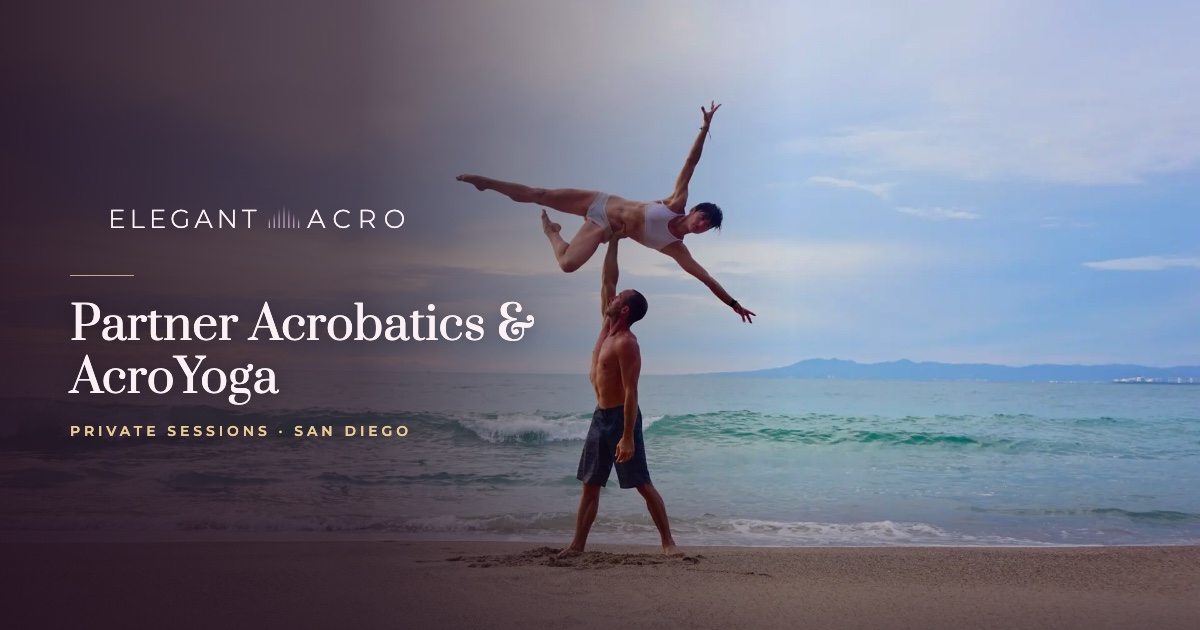 From the Elegant Acro home pageRead the whole page →
Can I come alone, or do I need a partner?
Either. Solo students train handstands, aerial, and conditioning with me directly — I base and spot everything. Couples and friends train together.
From the Elegant Acro home pageRead the whole page →What should I wear?
Fitted athletic clothing you can move in — leggings or shorts with a shirt that tucks or stays put upside down. Bare feet or grip socks. No jewelry.
From the Elegant Acro home pageRead the whole page →Is this good for a date or anniversary?
It is the date. Ninety minutes of laughing, holding each other up, and photographs you will actually frame. Gift sessions are available — just ask when booking.
From the Elegant Acro home pageRead the whole page →Do you teach kids?
Yes — acro is wonderful for kids and teens, and sessions are adjusted for age. Parents are welcome to join or watch.
From the Elegant Acro home pageRead the whole page →Where are you located?
A private indoor / outdoor facility in San Diego — the exact address comes with your booking confirmation. Out-of-town visitors welcome; many of my students are traveling through.
From the Elegant Acro home pageRead the whole page →Can we really do this as total beginners?
That’s who this is designed for. Progressions start on the ground, I base and spot everything, and most couples are flying recognizable shapes within the first hour.
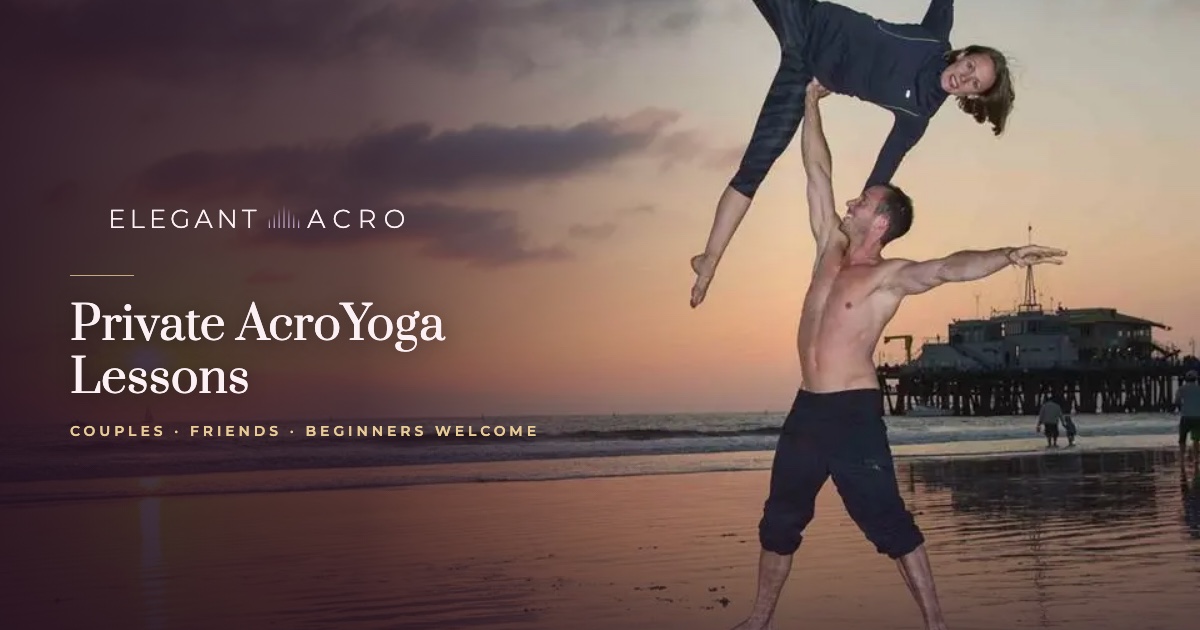 From the AcroYoga & Acrobatics pageRead the whole page →
I’ve never been upside down. Can I learn this?
Yes — handstands are built, not bestowed. We start against the wall or with my spot, and progress at exactly the speed your strength and nervous system allow.
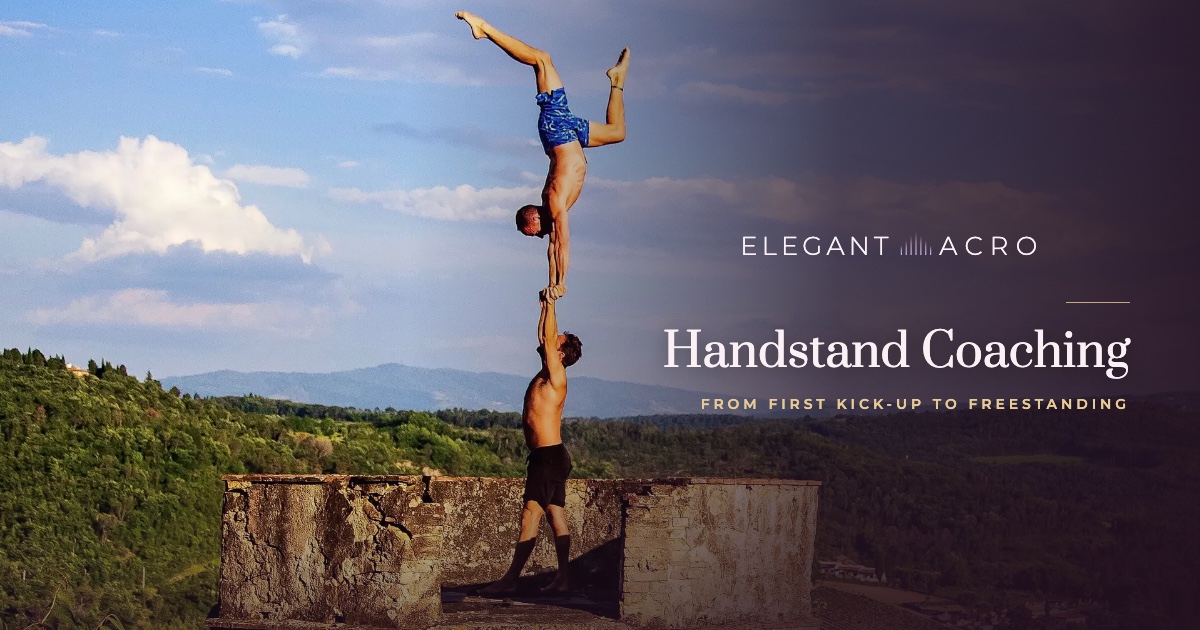 From the Handstands pageRead the whole page →
How intimate is "intimate"? What actually happens?
Fully clothed, completely tasteful partner acrobatics with an emphasis on connection — eye contact, breath, slow transitions, shared weight. Charged, never explicit; you set the temperature and I calibrate to it.
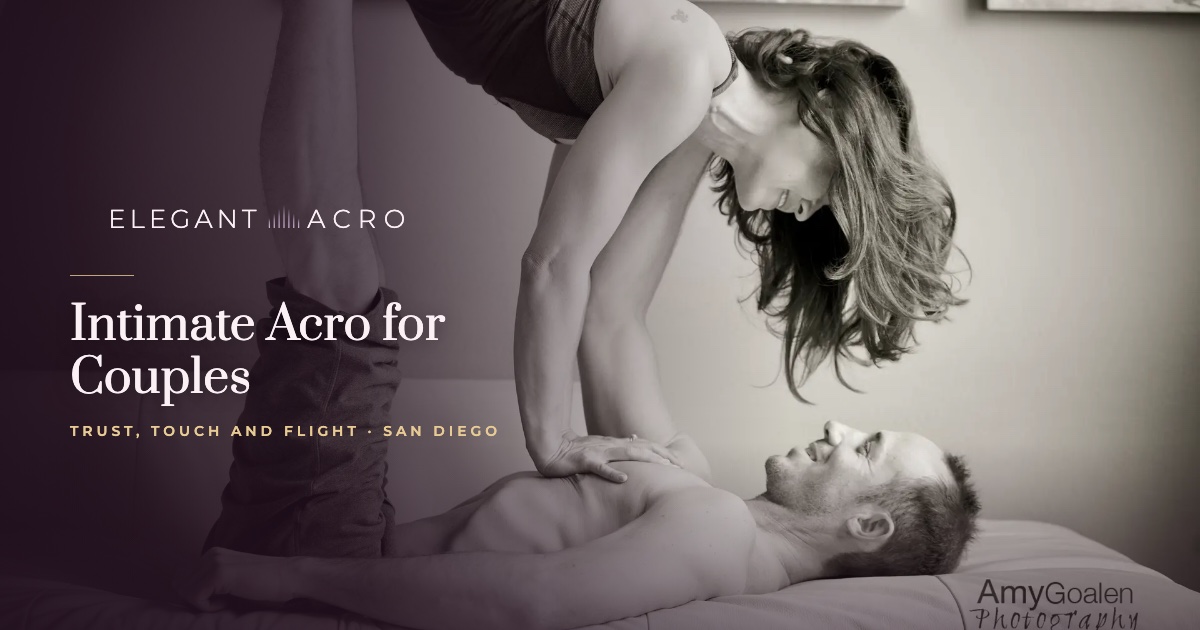 From the Intimate Acro pageRead the whole page →
What if we want it spicier?
I can keep pace or set a tone. Music, candles, soft plush and private atmosphere are all available. We can incorporate Thai massage, therapeutic flying, connected and sensual touch to give your partner an unforgettable experience.
From the Intimate Acro pageRead the whole page →Do we need acro experience first?
No — this is built for beginners. If you can hug and squat, we have everything we need.
From the Intimate Acro pageRead the whole page →5 questions
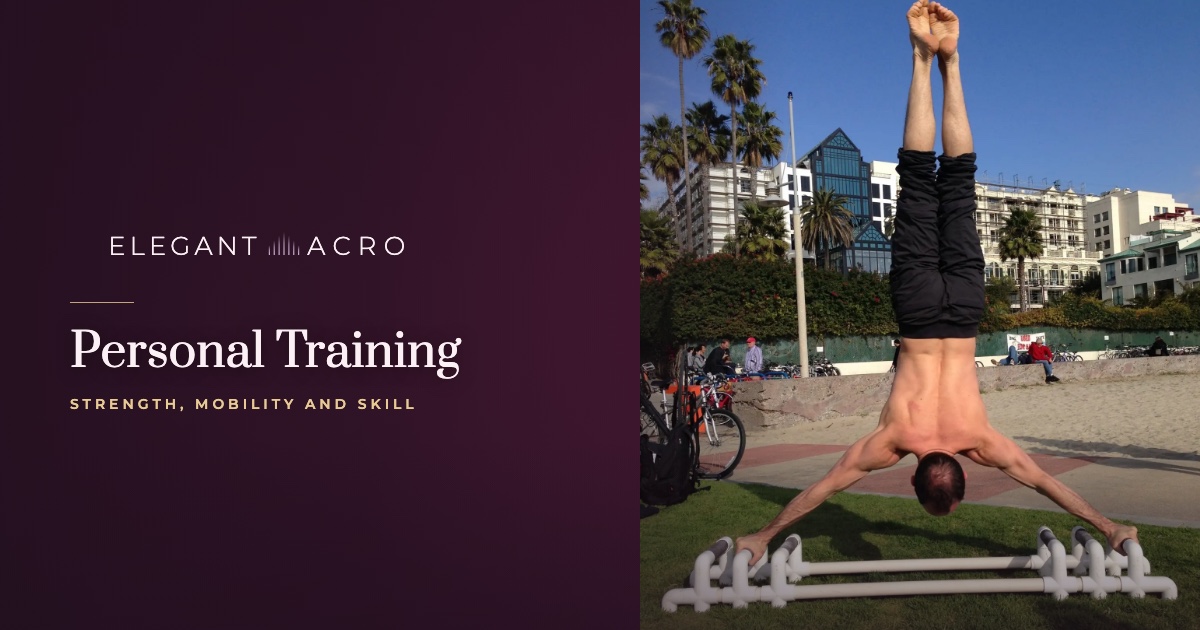
Personal Training
Strength, aerial and acro training, one on one.
What does a first session look like?
We talk for ten minutes about your goals and history, move for forty-five, and finish with a plan. You’ll train on day one — assessment happens through movement, not clipboards.
 From the Personal Training pageRead the whole page →
I’ve never lifted / never trained. Is this for me?
Especially for you. A private gym means nobody watches you learn, and every load starts where your body actually is.
From the Personal Training pageRead the whole page →Can training include acro or aerial?
Yes — that’s the house specialty. Many clients blend strength work with handstands or rig time in the same hour.
From the Personal Training pageRead the whole page →Where and when?
A private San Diego facility, seven days a week by appointment. Address arrives with your booking.
From the Personal Training pageRead the whole page →How often should I train to see results?
Ideally 3 times a week would be a great start to see change in as little as 6 weeks!
From the Personal Training pageRead the whole page →Nothing here says it quite like that
“” deserves an answer from me. Text it over and I’ll answer it myself.
Come get upside down
Your question isn’t on this page?
Text it to me. I read everything that comes in and answer it myself, usually the same day.
Private sessions in San Diego. Bring a partner, or just bring yourself.