
Tap any term to see the photos and the full definition.
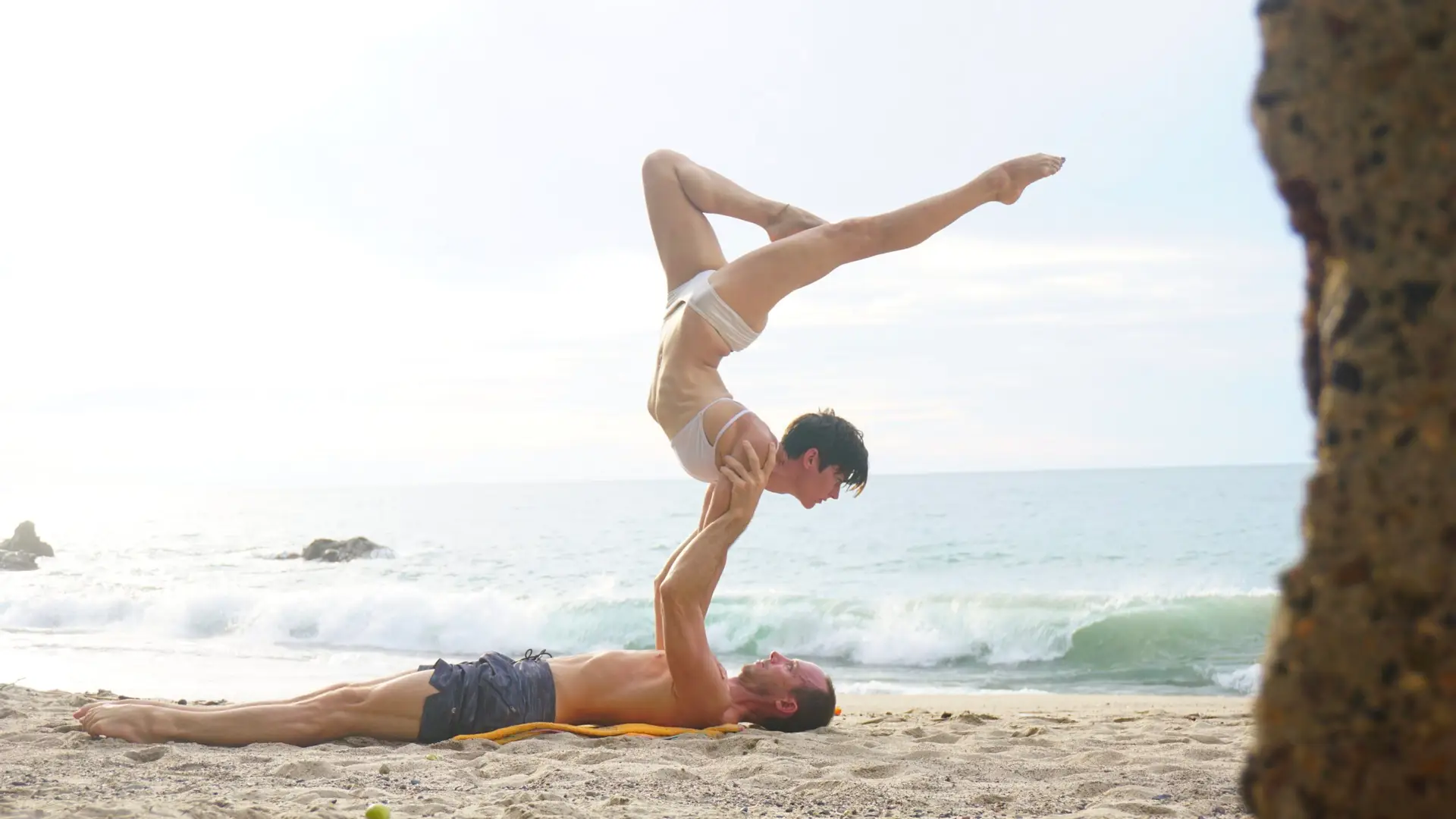
A blend of acrobatics, yoga, and Thai massage practiced between two or more people — one supports, one is supported. Traditionally there is a base, a flyer and a spotter. Each of these roles can be fluid, and it's critical for each new acrobat to learn and understand what's required of each. AcroYoga is not yoga, but takes elements from that lineage such as breath, connection and presence and brings it into the practice.
Learn it with me →The person either lying on the ground or standing under the flyer, providing the foundation, supporting the flyer's weight through hands and feet. Qualities the base engenders: strong, stable, stubborn, supportive, and life saving. In addition to looking out for their own wellbeing and life, the base always must be vigilant about where their flyer's head and body is in space, to keep them safe. It's the base's responsibility. The base is also ALWAYS in the role of the spotter, even if an additional spotter is present.
Learn it with me →The person lifted and supported in the air, learning to balance, trust, and move through shapes. The person who gets to fly. The person who gets all the attention in a performance. ◡̈ Qualities of a flyer are: tight, light, elegant, graceful and slow moving. Sudden quick movements are difficult to read and make it hard for a base to support you safely. The flyer has to have an extraordinary amount of aerial awareness to fly well.
Learn it with me →Quite possibly, the most essential part of practicing any acrobatic or aerial practice safely. While a base and flyer should never fully rely on a spotter for their own safety and well-being, it is critical that the spotter be attentive, aware, and understand exactly what they're doing and why they're doing it. The spotter should always ask questions about the skill: what skill are we doing? Where is this going to land? Will your arms be flying out in any direction? Where do you want the spot? Do you want hands-on? While a little overwhelming at first, it is one of the most rewarding and powerful roles you can be in.In simple terms, a spotter is a third person who watches for safety, ready to guide or catch — essential while learning new skills.The spotter may additionally employ tools, such as a spotting belt, or lines to keep the flyer safe.
Learn it with me →The quality of knowing where you are in space. Understanding what position your body is in and what effect and impact it's having on your base and on yourself. Understanding how to save yourself if you are falling. The quality of knowing where to apply pressure in your hands or feet to keep your line. The deep understanding of your muscles, your core, your line, and once you start performing making it all look pretty.
Learn it with me →Typically found in circus centers or on aerial rigs and circus training centers, lines or spotting belts are one and the same thing. It is a set of two ropes, connecting to a harness that the flyer wears around their waist. They firmly adjust the spotting belt to be snug and tight so that if a skill fails in any way, the belt is attached to the lines, which is attached to pulley which is attached to a rope, which is attached to the spotter's hands. The spotter then has full control over making sure the flyer lands safely on the ground. It's an incredible way to train because it allows you to practice new skills without injury.
Learn it with me →As implied, three people! A three high is three people standing on top of each others shoulders. Trio work can be done on the ground and standing up and is a tremendous way to get some extra support!
Learn it with me →Practicing great technique, proper alignment, connection, eye contact, touch, grip, and everything in between are all essential components to doing acrobatics well!
Learn it with me →The undeniable side benefit: acro photos that stop the scroll. After putting in all the practice, it finally feels great to show your friends and family what you can do.
Learn it with me →The base lies on their back with legs straight up to the sky, making an L with their body, and supports the flyer on their feet and hands. It's where most people begin AcroYoga, because the base's bones do most of the work instead of their muscles.
Learn it with me →The flyer balances horizontally on the base's feet, which sit at the front of the flyer's hip bones, arms open like wings. Usually the first pose people learn, and the one in every acro photo.
Learn it with me →The same idea face up: the base's feet support the flyer's lower back while the flyer arches open over them. A delicious, full-body stretch for the flyer.
Learn it with me →An upright seated pose in which the flyer sits balanced high on the base's feet, holding on for stability. Calm, steady and a great place for new flyers to find their balance.
Learn it with me →The flyer's shoulders rest in the base's hands as the flyer goes upside down into a wide straddle, held up on the base's straight arms. A classic first inversion.
Learn it with me →A therapeutic pose in which the flyer folds forward over the base's feet at the hips, arms and head hanging, so gravity gently decompresses the spine. Pure bliss after a hard training day.
Learn it with me →The flyer stands upright on the base's shoulders while the base stands too: the classic two-high. Built from a solid grip, locked legs and a base who doesn't move their feet.
Learn it with me →Linking poses together without the flyer touching the ground, so the practice moves like a dance instead of a series of tricks.
Learn it with me →A playful looping flow in which the flyer cycles through the same sequence of positions over and over, turning round and round like a load in a washing machine.
Learn it with me →Dynamic moves in which the base throws, or pops, the flyer into the air and catches them in a new position. Learned low, slow and with a spotter first.
Learn it with me →A circus discipline in which the base lies on their back and juggles the flyer with their feet, flipping and spinning them through the air.
Learn it with me →Partner acrobatics performed upright rather than on the ground — think hand-to-hand and shoulder stands, standing foot to hand, and most ubiquitously, bird, or the "dirty dancing" move. Most standing acrobatics are done at chest level for the base, or more impressively overhead.
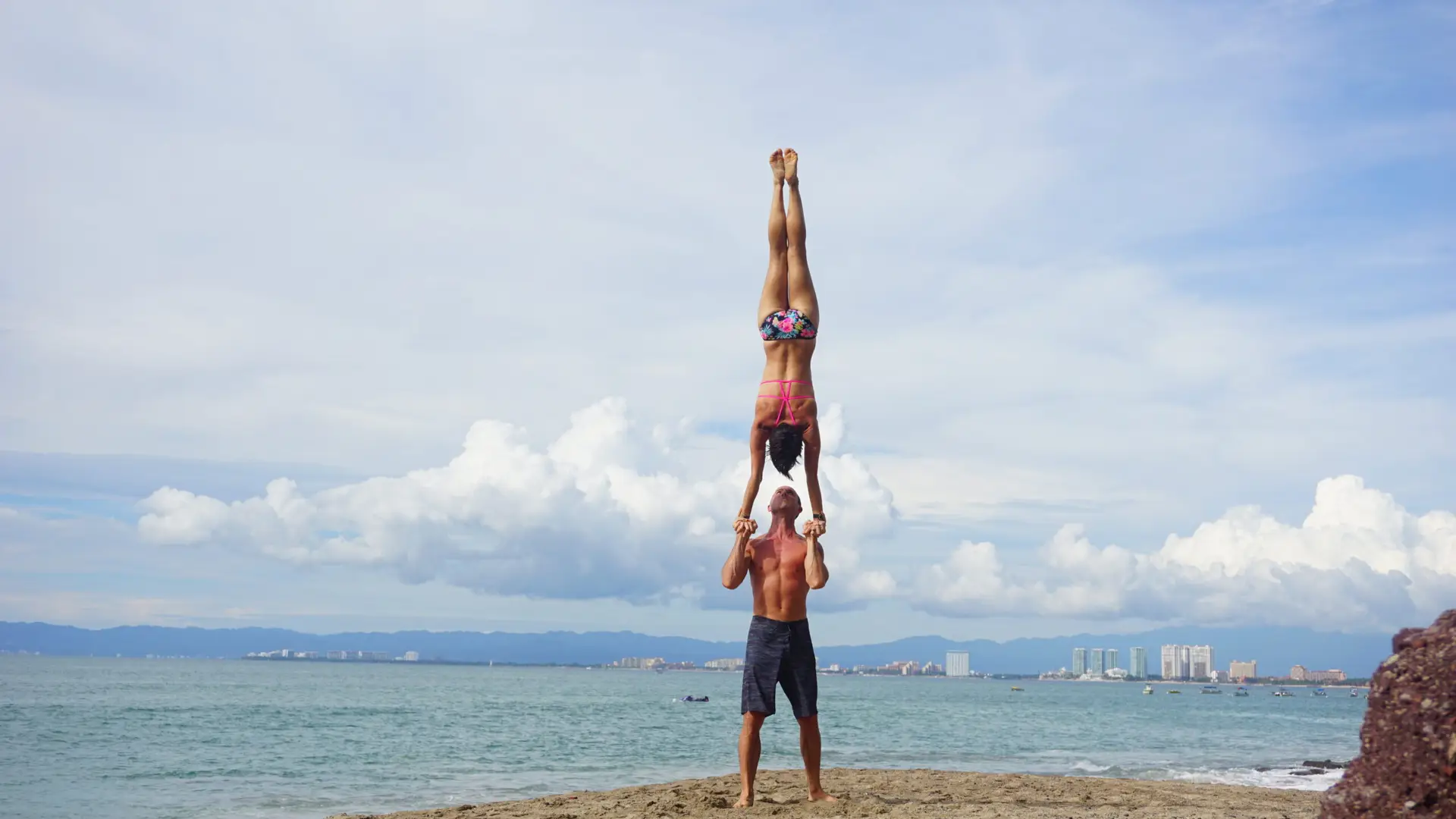
Learn it with me →An advanced skill where the flyer balances in a handstand on the base's hands, both standing. The name is a bit of a misnomer, however, because frequently a skill might involve foot to hand, or other parts of the body in flight. But hand to hand is most widely recognized by people doing handstands in other people's hands, or being flung in the air and landing in a handstand. Hand to hand can also be practiced on the ground, nice and low, to get used to the feeling.
Learn it with me →Two people leaning away from each other, using each other's weight to hold a shape neither could alone. Generally both people are falling forward or backward with control, to make the shape easier to hold.
Learn it with me →Shin to foot, hand to hand, foot to foot, foot to hand and hand to foot... you'll always understand the skill when you start from the top (Flyer) down (Base).
Learn it with me →Soft, passive, relaxing for the flyer. Intuitive, sensual, gentle and focused for the base. The therapeutics and soft, gentle acrobatics, or as I coined it, IntimateAcro can be done with a loved one, a family member, or can be made even more spicy and delicious with a lover or partner.
Learn it with me →If ever girl power was a thing, it's right here in acro. Yes ladies and girls can base too! And often more proficiently than some men because they have more flexibility or leg strength!
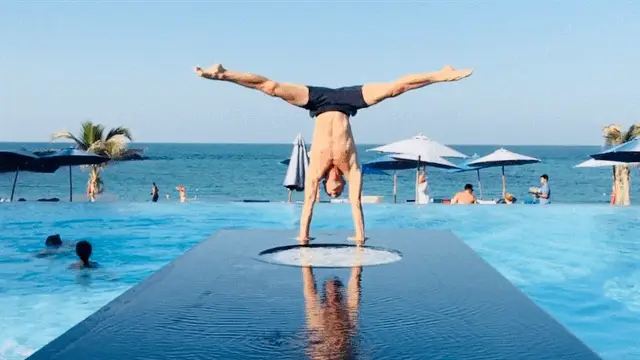
Learn it with me →The art of holding and moving in a handstand — control, alignment, and strength over raw flexibility. This is most traditionally what people think of when they say doing handstands. Hand balancing is also the art of doing handstands on objects and other people, such as on top of chairs, stages, blocks, cylinders and more.
Learn it with me →The straight vertical alignment from wrists through shoulders, hips, and toes that makes a handstand hold. The line is something every hand balancer aspires to, constantly working to straighten their line, perfect their line or at least make their line work for their body type.
Learn it with me →Shapes for entering and pressing to handstand, named for the position of the legs. Tuck = knees to chest. Pike = dropping two straight legs, pressed tightly together down towards your face, aiming usually for maximum compression. A straddle is similar but with legs open. Everything will be done with pointed toes, or there are consequences.
Learn it with me →Rising into a handstand slowly with control, without jumping or kicking up, generally using massive shoulder strength.
Learn it with me →The art of holding a handstand on different parts of the human body. It may be hands, but can be knees, feet, chest, head, thighs, arms and anywhere else there is a solid surface!
Learn it with me →A rare talent to stack the handstand line on top of a base's hip bones which are actively moving while they hold bridge pose. Attempt this one carefully and with a spotter!
Learn it with me →A frame or ceiling structure rated to hang aerial apparatus and spotting lines safely. Elegant Acro trains on a professional private rig in San Diego, so you can learn new skills on lines before you ever try them without.
Learn it with me →A short bar hung from two ropes, used for strength, balance and tricks. Static trapeze stays in place; flying trapeze swings.
Learn it with me →An aerial hoop, also called an aerial ring, that you climb into, spin on and pose in. Elegant, strong and very photogenic.
Learn it with me →Two long panels of stretchy fabric that you climb, wrap your body in and drop from. Equal parts strength, flexibility and nerve.
Learn it with me →Two padded loops that hold an aerialist by the wrists while they fly through powerful, slow shapes. One of the most demanding upper-body disciplines in the circus.
Learn it with me →Strength training built around the demands of acrobatics — wrists, shoulders, core, and control. Circus conditioning might look like traditional circuit training, such as leg lifts, situps, V-ups, lunges, pull-ups etc. But one of the best kinds, if you can find it, is doing so on an actual aerial apparatus, such as a trapeze, straps, lira, or rings. This way, the body is actually suspended in the air, and working on strength that is infinitely more challenging to acquire… But certainly more fun than push-ups.
Learn it with me →Flexibility you can control and move through under your own strength, not just passive range. Think bending your leg and lifting your knee to your chest, then straightening it out and holding it straight out with pointed toes, as high as you can. Most people struggle to get hip height, but your active flexibility is how high you can hold positions using effort.
Learn it with me →Passive flexibility is how far you can stretch when you are just relaxing into a pose. There are pros and cons to this. You certainly don't want to dump into your low back, or just collapse down. But if you just sat on the floor, opened your legs nice and straight, and then leaned forward, you would have a very good idea of what your middle splits passive flexibility is.
Learn it with me →Your body's sense of where it is in space — the quiet skill behind every balance. Very similar to aerial awareness, except you don't have to be in the air.
Learn it with me →Usable range of motion through a joint — the foundation that keeps acrobatics safe and sustainable. All the rage in training right now as it is believed to be one of the secrets to a long lasting life.
Learn it with me →Working skills based in traditional gymnastics, to become a healthier, more acrobatic version of yourself.
Learn it with me →No term matches that yet.
Want it explained? Ask me, and I'll add it.


Off the mat, I also work as an intimacy coach. If that’s ever useful, you’ll find me at closeness.com.